Why Doubting Yourself as a Therapist is a Good Thing.

One of the hardest things about being a therapist is worrying about questions that have no clear answer. Do I properly understand what my client needs?  Would a different approach be more effective? Should I have comforted them when they were upset more quickly? Or was letting them sit in that distress a moment longer what they needed to understand themselves?

Reading research related to mental health doesn’t make things much clearer. Any neat causal theory that attempts to explain mental illness is an oversimplification.  A dizzying range of both biological and environmental factors have been shown to play a role. Confusingly, research suggests people can present with similar symptoms that have different causes. One person’s depression largely caused by environmental factors, another by genetic sensitivities.

The research on treatment is similarly unclear. Medication works for some people but not others, therapies with completely different approaches often have similar results. Talk to enough people who have recovered from mental illness and what stands out is how different their stories are. One person will say accepting their depression and being kinder to themselves helped them get better, another that it was only when they took responsibility and demanded more from themselves that things improved. Some clients with addiction say complete abstinence worked for them, others say giving up on abstinence in favour of moderation helped them break the cycle of binges. To be a therapist is to try and help a client find a path that you yourself cannot see.

The best therapeutic modalities are honest about this uncertainty. They warn that a therapist who thinks they know exactly what a client needs is probably suffering from overconfidence. Motivational interviewing talks about partnership, psychodynamic therapists’ “neutrality” and CBT therapists “collaborative empiricism,” but the underlying message is the same: The client is the expert in their own life, and their ideas about what is wrong and what needs to happen are likely to be at least as accurate as the therapist’s.

Every now and then a group of therapists becomes bored with these constraints. They will market their approach as guaranteed to help with any mental illness, have a model that makes sweeping generalisations about mental distress. Therapy becomes more about teaching the client the model than actually listening to them. Usually it doesn’t take long for their approach to backfire. A recent article in The Cut is a great example of this. It details the excesses of a private treatment facility ran by a charismatic yet overconfident IFS practitioner. Therapists told clients they knew exactly what was wrong with them, told them to cut ties with their family, made them adopt concepts and ideas that left them more disturbed. Unsurprisingly this led to significant harm. People were left estranged from their families, convinced they had suffered things that hadn’t actually happened.

The history of therapy and psychology is littered with similar examples.  The refrigerator mother theory of autism, rebirthing therapy, recovered memories. All of them are examples of therapists becoming sick of the murky, cautious work of therapy and wanting something more definite. Wanting to tell people exactly what is wrong with them, what they need to do to get better. What is often striking about these stories is the energy and enthusiasm with which these therapists worked. To feel like you know exactly what each client needs and that you can give it to them must be an intoxicating feeling.

 In my weaker moments I sometimes wonder if changing the way I work could reduce the amount of uncertainty I feel. Maybe if I used a manualised approach with every client I wouldn’t spend so much time doubting myself. If the client didn’t get better it would be the model’s fault, not mine. In the end though I always decide that would be dishonest. How could I tell a client they need to adopt a particular approach when I know that other approaches can be just as effective? Or tell them they need to learn a particular skill that many happy people never use? The only way therapy makes sense for me is that every therapeutic engagement is unique to each client, and that’s where the doubt creeps in.

Before I became a therapist I was a banker. I put together business loans that my credit team would agree to. When I made a mistake it was always clear what had gone wrong: I hadn’t applied the right lending policy, forgotten to ask the client to fill out a particular form.  My job was to follow a process as closely as possible, if I did things differently or was creative it was almost always a mistake. As I was working on this piece I was reminded of how I hated that feeling. It made me think that I should be more grateful of how uncertain my current job is. Being a therapist allows me to wrestle with questions that have no clear answer, experiment with new approaches to difficult problems. While at times I can find the existential anguish that comes with it challenging, I know I’d like the alternative even less.

I also believe that the feeling of uncertainty makes me a better therapist. It keeps me open minded, forces me to listen more closely, pushes me to try new things. If therapy is most effective when it is collaborative, how can it truly be collaborative if the therapist knows exactly where they want to go? It is only when both the client and the therapist feel somewhat lost, are both closely listening to each other for a sense of direction that collaboration can emerge.

This isn’t to say being a good therapist means being passive. To be passive is also a decision, and clients need more from us than simple reflections. The paradox of being a therapist is you are forced to take a position whilst being aware that your position could be wrong. Perhaps learning to embrace this uncertainty without becoming overwhelmed by it is the fundamental challenge of therapy.
Like reading about therapy?

Enter your email below to receive updates whenever I have a new post.

The Benefits of Collaboration

The insights from therapy my clients find most useful generally occur spontaneously. They come from conversations where both of us were struggling with a question that we didn’t know the answer to. Looking back on these moments it’s often unclear who even came up with the insight. They said something, I said something back, and eventually what emerged was better than anything either of us could have thought of individually.

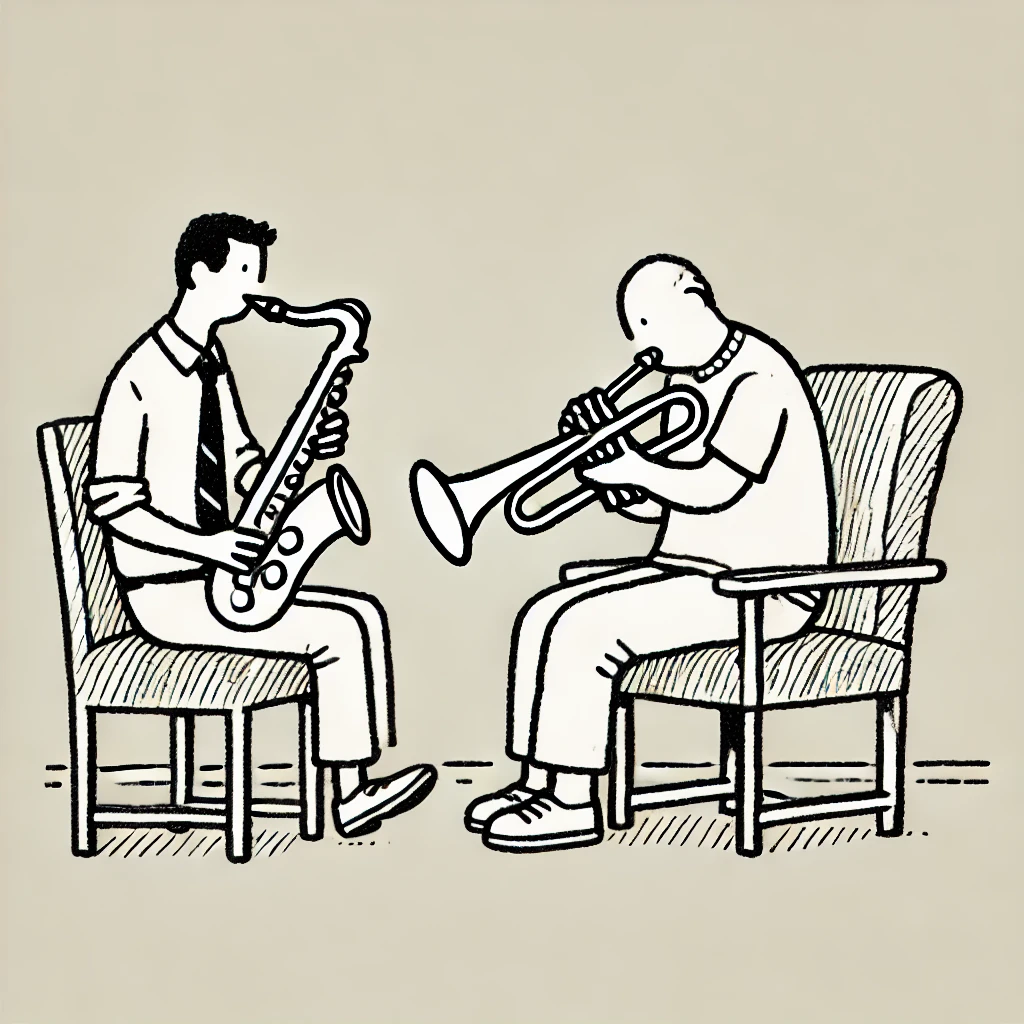
The benefits of these types of collaborative interactions aren’t confined to therapy. Jazz and Blues music is built off the idea that what spontaneously occurs when people interact is better than anything that could be written beforehand. Hollywood uses writers’ rooms because studios know collaboration can lead to better outcomes than individuals working alone. While our current culture values stories of individual genius, many of our best innovations, be they artistic or technological, came through collaboration.

Not all conversations are truly collaborative though. For starters, you need to be actually listening to the other person. If you’re too focused on what you’re doing you’ll just keep building in one direction and never add anything to what the other person is saying. You also need to be comfortable with uncertainty. Pressure to come up with an answer can make you jump on the first possible solution, potentially cutting off the richer idea that could have emerged if you’d allowed the interaction time to develop.

To make things harder, our society tends to value advice over collaboration. When we have a problem, we are told to consult an expert. In exchange for money they provide us with an answer that is better than anything we could come up on our own. If you hired a lawyer and they wanted to start brainstorming different legal strategies with you, you’d probably ask for your money back.

Despite knowing the benefits of collaborative interactions, psychologists feel this pressure as well. Most of us tend to market ourselves based on the knowledge we can provide our clients. It is simpler to tell someone that you can help them by teaching them something rather than trying to explain the benefits of insight-driven therapy. Giving them answers also feels satisfying. My easiest sessions are when clients are asking me for specific information. What I’m providing feels much more definite and tangible than trying to engage them in a collaborative conversation and hoping we can come up with something. However, the information I give in those moments is rarely what clients truly value from therapy.

A lot of the ways we are told to act in our professional lives also stifles collaboration. We are told to go into conversations with clear goals, to always remember our individual contributions lest we are passed over for promotion, to set agendas for meetings. While I understand the logic of this advice, I worry that the costs might be vague enough that they are overlooked. How can you even be aware of potential collaborative insights that were never even arrived at?

 More generally, a society that places a premium on expertise and agendas over collaboration is a society filled with people who struggle to collaborate effectively. In initial sessions my clients are often uncomfortable engaging in the sorts of conversations that can lead to insights. They don’t like speaking speculatively, will want to pre-plan agendas, will ask me to answer questions before they’ve even properly explored what the questions are. For these clients it is often a desire for accuracy that is holding them back. They feel that the serious nature of a therapeutic room requires them to only say things that they are sure are entirely accurate. They are like a musician so scared of playing the wrong notes that they repeat the same scales instead of truly improvising. It is only when they feel comfortable expressing things that they are unsure of, of responding in the moment to things I say, that we can start to build insights they find valuable.

I’ve written this piece to try and explain one of the main ways therapy is helpful, but also to encourage people to have more collaborative interactions in their daily lives. Collaboration shouldn’t be reserved to jazz bars, writers’ rooms and therapists’ offices. If you currently have a problem that has you stumped, try talking to other people about it.  Solutions will come from those conversations that you would have never thought of on your own. And the next time someone comes to you for advice, resist the urge to respond with the first thing you think of. Allow the problem to develop, kick it around, and hopefully something will emerge that is much better than your original solution.

My Treatment Effectiveness In 2024

Like reading about therapy?

Enter your email below to receive updates whenever I have a new post.

I started my own practice in January last year. For the first time I was responsible for everything about my work. What sorts of clients I saw, how often I saw them, the interventions I used. While this is what I wanted, part of me wondered if I was ready for all this clinical responsibility.


As a result, I decided to try and measure my client outcomes more methodically . I’d already been convinced by a lot of the literature around the benefits of treatment outcome monitoring, and thought it would give a more objective answer to the “do I really know what I’m doing?” thoughts that sometimes keep me up at night. I chose the Core 10 because its brief, and unlike some measures has questions about functioning (I felt I have been able to cope when things go wrong, I felt I have someone to turn to for support when needed) as well as questions about mood.


For simplicity I only included adult clients doing individual therapy through Medicare (I also ran some group therapy during the year). I also excluded clients I had seen previously as I’d already used a different measure with them. I used Novopsych to administer the Core-10 before the first session, then again at sessions 6 and 10. That way it was linked to GP letters I sent. I made it clear to clients that completing the Core 10 was optional, and if a client didn’t complete if after multiple reminders I would forget about it. Outcome measurement purists would probably think this regimen is incredibly sloppy, but I knew if I made it more rigorous I probably wouldn’t stick to it.

Data Collection


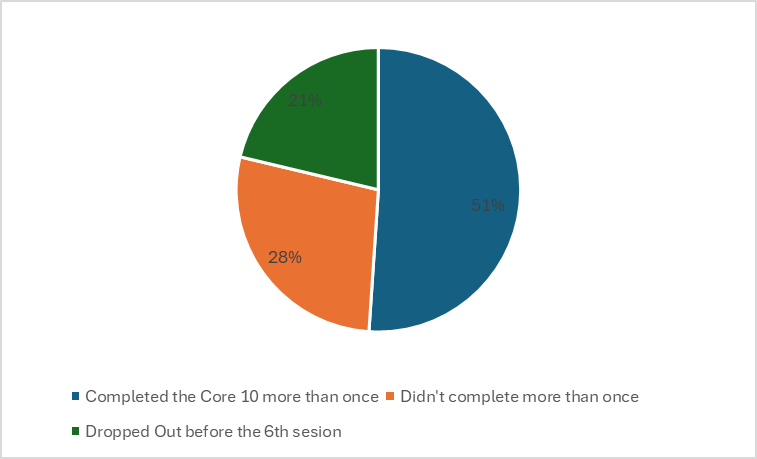
The below pie chart has my dropout % and the % of clients who did the Core 10 more than once.

Of the clients that completed at least six sessions of therapy, around one third didn’t complete the Core 10. It’s possible the 1/3% non completion rate inflated my effect size but I don’t think so. The clients who didn’t complete the Core-10 verbally reported being just as satisfied with therapy. Not doing the Core 10 seemed to be mainly driven by forgetfulness on my or the clients part.

My Effect Size


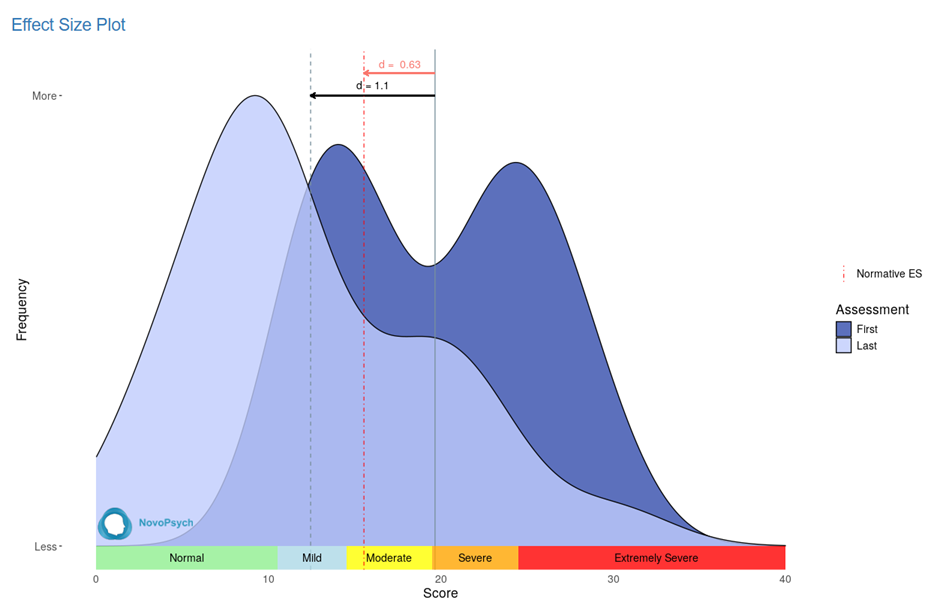
Of the the clients who did complete the Core 10 more than twice, Novopsych calculated my effect size as 1.1. Put another way, the average client that completed therapy with me went from scoring in the “severe” range on the core 10 to the “mild range.”

This is a good effect size for therapy, and is on the higher side when compared to most studies of therapists effect sizes. More importantly it is a large and meaningful change, and makes me feel my work was worthwhile. Therapy might be expensive and time consuming, but for my clients it appeared it made a meaningful difference in their mental health.

What I want to Work On

As my effect size is on the high side, I think probably the biggest improvement I could make is trying to reduce my dropout rate. A 21% drop out rate is roughly in line with the literature, but it could also be better. Some of my clients who dropped out of therapy did so they moved away, or felt the therapy was done, or got busy with other things, but some on them dropped out because therapy wasn’t working. They were clients I didn’t engage with properly, or misunderstood, or where I tried somethingthat didn’t work. I want to try and make less of these mistakes this year. It will involve focusing more in initial sessions oon engaging clients and being alert to potential misunderstandings. I might write something more detailed in the future about how I plan to do this.

Final Thoughts

I’m glad I did routine outcome monitoring last year, and am going to do the same thing this year hopefully, with a little more rigour. Not only is it helpful in noticing overall trends, it was for individual clients. Sometimes you think therapy is going well for a client, but their mental health scores aren’t improving. I’ve found that usually that means something else is going on that isn’t being talked about in therapy, and this can be a prompt to explore that. More broadly, as health a health professional, it’s important to measure if what you’re doing is effective. Outcome monitoring is an easy way of doing that which doesn’t take much time.